

About the Capable Community Framework
The Capable Community Mission
To strengthen communities by equipping individuals and households with the knowledge, skills, and mindset needed to navigate disruption with confidence—reducing risk, improving outcomes, and building resilience from the ground up.
A Framework for Readiness in the Real World
The Capable Community Framework is a structured approach to preparedness, resilience, and risk awareness—designed for real people living real lives in an increasingly complex and interconnected world.
Rather than focusing on isolated skills, gear, or single-event scenarios, the framework addresses how individuals, households, and communities function as systems before, during, and after disruption.
At its core, the Capable Community Framework recognizes a simple truth:
Communities are only as resilient as the people within them.

Why a Framework Was Needed
Preparedness is often fragmented.
Some approaches focus only on emergency response.
Others emphasize supplies without planning.
Many rely on fear, unrealistic scenarios, or one-size-fits-all advice.
What’s often missing is a coherent structure—a way to connect awareness, planning, decision-making, and action across different hazards, life stages, and community contexts.
The Capable Community Framework was developed to fill that gap.
It provides a common language and structure for readiness that works across:
• Personal and household preparedness
• Community-level resilience
• Organizations, schools, and local systems
• Everyday disruptions as well as major emergencies
Built for International Use
The Capable Community Framework was designed to be hazard-agnostic, jurisdiction-neutral, and culturally flexible.
It does not depend on:
• Specific government agencies or legal structures
• National emergency management doctrines
• U.S.-centric terminology or assumptions
• High-resource environments
Instead, it aligns to functions, not organizations—making it usable in urban and rural settings, high- and low-resource environments, and across different political and cultural systems.
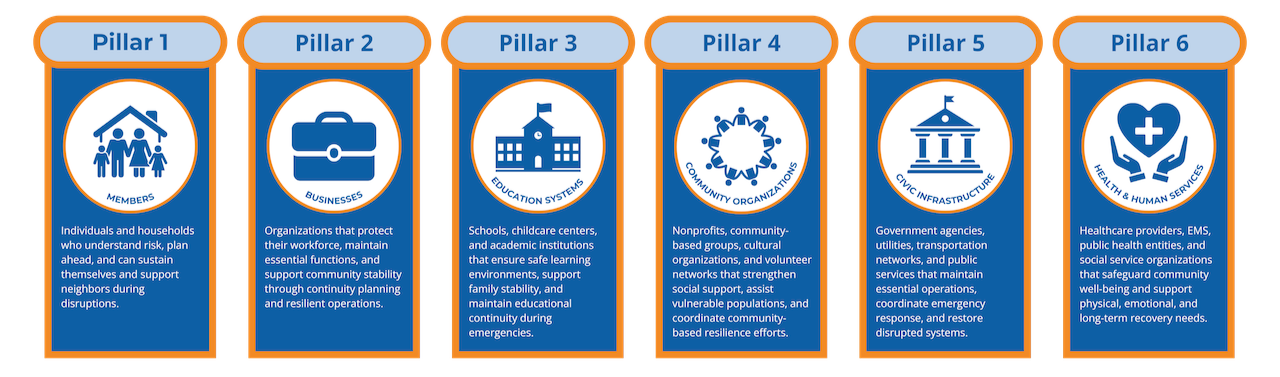
Pillar 1: Members (Individuals & Households)
People and households who understand risk, plan ahead, and can sustain themselves and support others during disruption. This pillar is universal—every emergency is experienced first at the individual and household level.
Pillar 4: Community Organizations
Nonprofits, faith-based groups, cultural institutions, volunteer networks, and mutual aid organizations that provide social cohesion and reach vulnerable populations.
The Six Pillars of a Capable Community
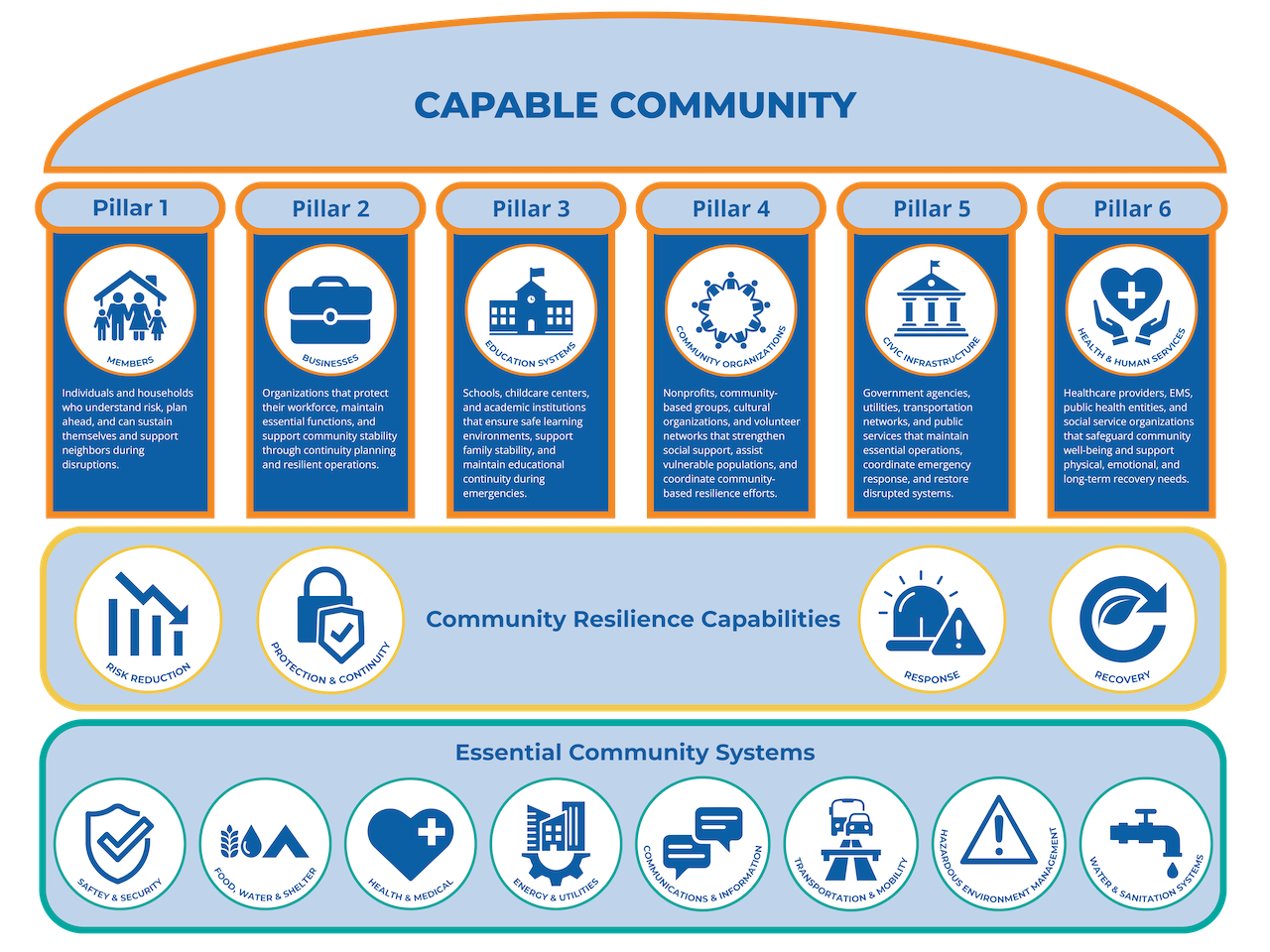
At the top of the framework are the six pillars, representing the universal contributors to community resilience. While names and structures may vary globally, these pillars exist in every society. Each pillar represents a role, not a rigid structure—allowing global communities to map their own systems onto the framework.
Pillar 2: Businesses
Formal and informal economic entities that provide goods, services, employment, and continuity. Globally, this includes small enterprises, markets, cooperatives, and large organizations alike.
Pillar 5: Civic Infrastructure
Public institutions, utilities, transportation networks, and governance systems responsible for coordination, essential services, and system restoration—regardless of governmental form.
Pillar 3: Education Systems
Schools, childcare, training centers, and learning institutions that support safety, stability, and continuity of education during disruption—formal or informal.
Pillar 6: Health & Human Services
Healthcare providers, emergency medical services, public health functions, and social support systems that protect physical, emotional, and long-term community well-being.

Beneath the pillars are four resilience capabilities—functions that every community must perform to manage disruption, regardless of hazard or location. These capabilities are intentionally aligned with internationally recognized resilience and disaster risk reduction concepts while remaining accessible to non-technical audiences.
Risk Reduction
Identifying hazards, understanding vulnerabilities, and reducing exposure through planning, education, and mitigation.
Protection & Continuity
Safeguarding people, livelihoods, and essential functions while maintaining or rapidly restoring critical activities.
Response
Coordinating actions during disruption—communication, decision-making, and resource use under pressure.
Recovery
Restoring systems, supporting affected populations, and adapting after disruption to reduce future risk.
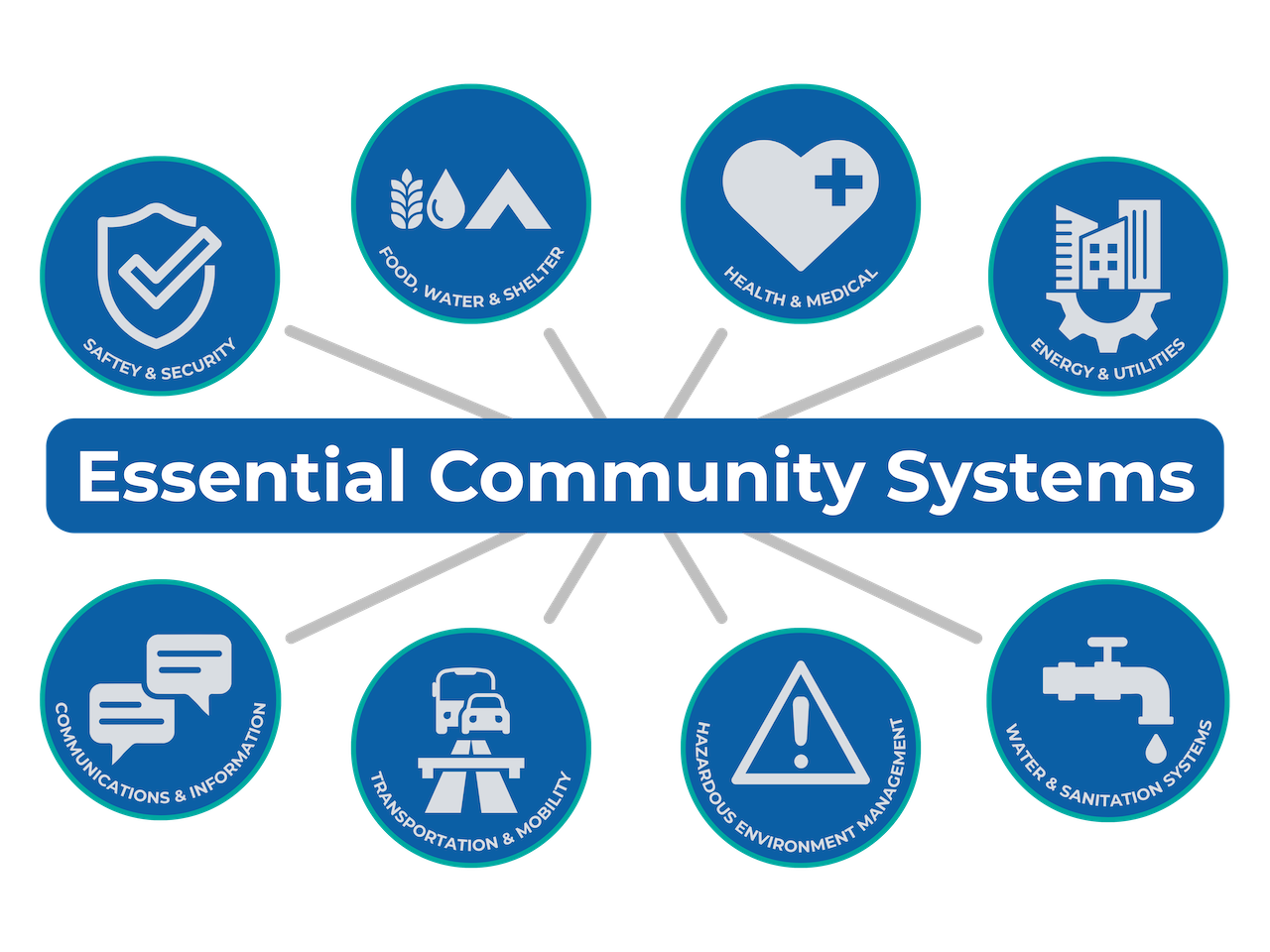
At the foundation of the framework are Essential Community Systems—the services that sustain life and stability in every society.
These systems exist globally, even when they are organized differently.
They include:
• Safety & Security
• Food, Water & Shelter
• Health & Medical
• Energy & Utilities
• Communications & Information
• Transportation & Mobility
• Hazardous Environment Management
• Water & Sanitation Systems
By focusing on systems rather than providers, the framework remains applicable across countries with different infrastructures, governance models, and resource levels.
A Common Language for Global Preparedness
The Capable Community Framework provides a shared, non-political language for preparedness and resilience. It enables households, organizations, NGOs, and governments to align efforts without needing identical policies or structures.
This makes it especially effective for:
International education and training
Community-based resilience programs
Cross-border or multi-jurisdiction initiatives
NGOs and humanitarian organizations
Public-private partnerships
The framework adapts to local context while preserving a consistent structure for planning and evaluation.
From Framework to Action
The Capable Community Framework is designed to be used, not admired.
It serves as the foundation for:
Training and education programs
Household and organizational planning
Scenario-based exercises and decision-making
Community resilience initiatives
Long-term preparedness and recovery strategies
All Capable Community courses and tools are aligned to this framework to ensure clarity, consistency, and real-world applicability—anywhere in the world.